
Business Guide
How to Start a Party Rental Business: A 10-Step Guide
Everything you need to launch a profitable party rental business, from choosing your niche to landing your first customers.
December 17, 2025 · 12 min read
The party rental industry continues to grow year after year. Weddings, corporate events, school functions, and backyard celebrations are not slowing down. But turning that demand into a sustainable business takes more than buying chairs and launching a website. This guide walks through the exact steps successful operators follow, with real-world context and practical advice, and shows how modern rental businesses use tools like Party Rental Studio to avoid the mistakes that stall growth.
Massive Market Growth
The global party supply rental market is projected to grow at a CAGR of 15.36% through 2032, representing billions of dollars in opportunity.
Recession Resistant
Even in tough economic times, people still celebrate life's important milestones, keeping demand steady year-round.
Healthy Profit Margins
Typical profit margins for event rental businesses range from 10% to 40%, with high-efficiency operators earning even more.
The global party supply rental market is experiencing explosive growth, with a projected CAGR of 15.36% through 2032. What makes this particularly attractive is the recession-resistant nature of the industry, as even during economic downturns people continue to celebrate weddings, graduations, and milestone events.
From a profitability perspective, well-optimized operations can achieve margins of 45% or higher during peak seasons. The business model is particularly attractive because each piece of inventory becomes a recurring revenue generator. A single Chiavari chair purchased for $45 can generate $2,000+ in revenue over its lifetime through repeated rentals.
The wedding segment alone accounts for approximately 35% of the entire rental market, with corporate events and private parties comprising the remainder, providing multiple revenue streams and reducing dependence on any single event type.
Choose Your Niche
The most common mistake new rental business owners make is attempting to serve every market segment simultaneously. This approach dilutes resources, prevents specialization, and makes it impossible to excel in any particular area. Successful rental businesses start with a focused niche, establish dominance, then expand strategically.
Weddings: This segment offers the highest profit margins but demands perfection. Wedding clients expect premium inventory like Chiavari chairs, elegant linens, and sophisticated decorative elements. Pricing is premium: Chiavari chairs typically rent for $8-12 each, with tablecloths commanding $8-15 per rental. One late delivery or quality issue can result in damaging reviews that impact future bookings.
Corporate Events: This segment values reliability and scale over aesthetics. Companies need stages, audio-visual equipment, large tenting, and seating for hundreds of attendees. Orders are larger, clients are often repeat customers, and corporate contracts can reach $50,000+ for major events.
Backyard Parties and Private Events: This high-volume segment operates at lower price points but offers predictable, consistent demand. Popular items include bounce houses, folding chairs, tables, and concession equipment. During peak summer months, equipment can turn over 3-4 times per weekend.
The strategic approach is to select one niche, build reputation and expertise, then expand into adjacent markets once systems and capacity are established.
Write a Party Rental Business Plan
Most business plans gather dust in a drawer. The best ones are living documents referenced weekly, answering the hard questions that will keep you up at night.
Who are your competitors and what are they doing wrong? Spend two weeks mystery shopping every rental company in your area. Call for quotes, read reviews, and identify gaps. Most companies have terrible customer service and outdated websites. That becomes your competitive advantage.
What's your pricing strategy? Pricing too low is the fastest way to go broke. Factor in depreciation, cleaning time, fuel costs, storage, and your own labor. A solid formula: purchase price divided by 10 rentals equals your minimum rental rate. A $50 tablecloth rents for $5 minimum, but aim for $8-10 depending on event type.
How will you fund initial inventory? A typical starting point is $15,000 from savings plus a small business loan, enough for 50 tables, 400 chairs, and linens. Within six months, the inventory can pay for itself, and profits reinvest into expansion. Include realistic financial projections and hold yourself to them.
Secure Proper Licensing and Insurance
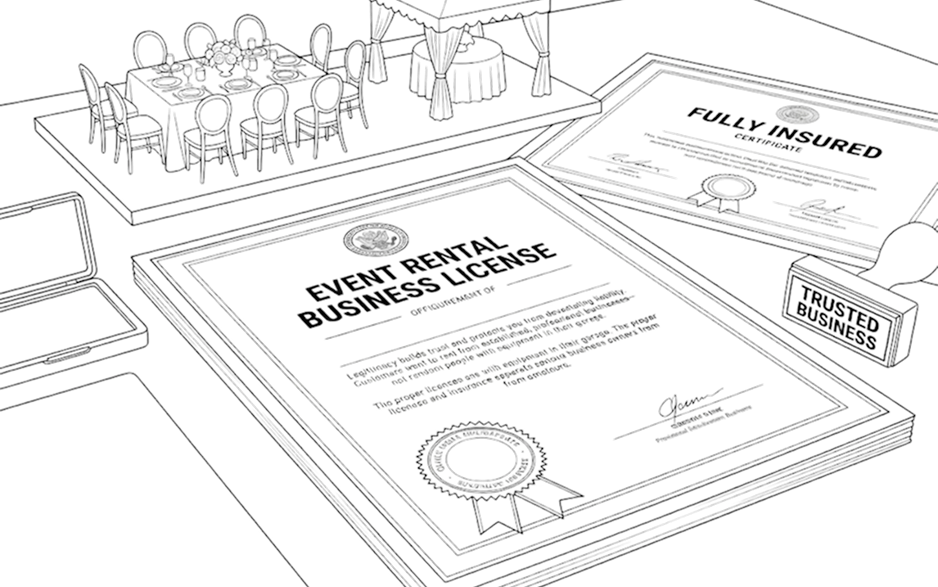
Operating without proper legal protection exposes the business to catastrophic risk. A single lawsuit from an equipment failure or injury could bankrupt an uninsured operation.
General Business License: Requirements vary by jurisdiction, but most cities require a general business license to operate legally. Costs typically range from $50-$300 annually. Operating without proper licensing can result in fines and prevent partnerships with venues and event planners.
Sales Tax Permit: Most states require rental businesses to collect and remit sales tax. The permit is usually free but comes with significant compliance responsibilities. Modern accounting software automates tax tracking and filing, reducing administrative burden and error risk.
Insurance Is Non-Negotiable: General Liability Insurance protects against accidents, injuries, and property damage. A comprehensive policy providing $1-2 million in coverage typically costs $2,000-$3,000 annually. Many venues require proof of insurance before allowing rental companies to operate on their premises.
Safety Standards and Compliance: Businesses renting inflatable equipment must comply with ASTM F2374 safety standards. Many states mandate annual inspections for bounce houses. Certified inspectors cost $500-$1,000 annually but provide legal protection and ensure customer safety.
Calculate the Cost to Start a Party Rental Business
The most expensive mistake new rental business owners make is purchasing specialty items that rarely rent while high-demand basics are constantly booked out. The 80/20 rule dominates the rental industry: approximately 80% of revenue comes from 20% of inventory.
Start with High-ROI Essentials
White folding chairs are the foundation of any rental inventory. Purchasing 100-200 chairs at $10-15 each provides immediate rental opportunities. At $2-3 per chair rental, they pay for themselves in just 3-5 rentals. Quality chairs generate 200+ rentals over their 5-7 year lifespan, representing returns of 4,000% or more.
Rectangular tables in 6-foot and 8-foot lengths have universal demand across all event types. Purchase costs range from $50-70, with rental rates of $8-12. These tables pay for themselves in 6-8 rentals and continue generating profit for years.
White linens (rounds and rectangles) cost $8-15 to purchase and rent for $8-15 each. With proper cleaning systems, quality linens provide 40-60 rentals before retirement, generating exceptional returns on investment.
Build Inventory Strategically Using Data
After establishing core inventory, expansion should be driven by booking requests and market analysis. Tracking inquiries reveals unmet demand. If 30% of wedding inquiries request Chiavari chairs that aren't available, investing $4,500 in 100 chairs addresses documented demand rather than speculation.
Expand Based on Market Demand Data
Systems like Party Rental Studio provide analytics showing which items are most frequently requested, which have the highest utilization rates, and which generate the most revenue per dollar invested. This data-driven approach to inventory expansion maximizes ROI and prevents capital waste on low-demand specialty items.
Quality Trumps Quantity
Purchasing cheap equipment creates false economy. Discount chairs fail after 20-30 rentals, requiring constant replacement. Mid-to-high quality equipment lasts 5-7 years, reducing long-term costs and maintaining a professional appearance. Customer satisfaction depends on delivering equipment that looks good and functions perfectly.
Set Up Your Pricing and Delivery Fees
Pricing determines whether a rental business generates wealth or barely survives. Too many new operators compete on price, creating a race to the bottom that leads to burnout and business failure.
Formula-Based Pricing
The baseline approach charges 10-15% of purchase price per rental. A $50 table rents for $8-10. A $200 speaker system rents for $100-150. This formula ensures equipment pays for itself quickly while generating ongoing profit. High-demand weekends during peak wedding season (May-October) justify premium pricing 20-30% above baseline.
Delivery Fees Cover True Costs
Free delivery is rarely free: it's either absorbed into pricing or represents lost profit. Implement a tiered structure:
- 0-10 miles: $75-100
- 10-20 miles: $125-150
- 20-30 miles: $200-250
- Beyond 30 miles: Custom quote
Complex installations requiring extensive setup warrant additional fees of $150-300 depending on scope and duration.
Compete on Value, Not Price
Operators who raise prices 20-25% while emphasizing service quality typically lose 15% of inquiries but double profit margins. The retained customers value reliability, quality equipment, and professional service over rock-bottom pricing, and they generate the best referrals.
Use Software to Manage Logistics
Attempting to manage a rental business with spreadsheets is the operational equivalent of building a house with hand tools when power tools are available. Manual systems create chaos, errors, and catastrophic mistakes. The most expensive mistakes, including double-bookings, forgotten deposits, and lost inventory tracking, are all preventable.
Party Rental Studio: Comprehensive Operational Management
Automatic Inventory Tracking: Setting chair quantity at 400 automatically adjusts availability as bookings are made. When someone books 200 chairs for Saturday, the system displays only 200 available for other Saturday bookings, eliminating double-booking disasters.
Centralized Customer Management: Every inquiry, quote, booking, and communication lives in one searchable database. Customer history is instantly accessible, enabling personalized service and efficient follow-up.
Automated Invoicing and Payment Processing: The system generates professional invoices, tracks deposits, sends payment reminders, and processes transactions. Automated reminders reduce average accounts receivable from 45 days to under 15 days, dramatically improving cash flow.
Visual Calendar Management: Month-at-a-glance visualization shows all bookings, available inventory, and scheduling conflicts. Color-coding and filtering help operators manage complex schedules across multiple event types.
Business Intelligence and Analytics: Data on inventory utilization rates, revenue per item, customer lifetime value, and profitability by event type drives strategic decisions about expansion, pricing, and market focus.
ROI snapshot: The investment of $100-300/month for rental management software saves 15-20 hours weekly and prevents mistakes that can cost thousands. The ROI exceeds 1,000% when accounting for time saved, errors prevented, and growth enabled by operational efficiency.
Build a Website That Generates Leads 24/7
A professional website functions as a tireless salesperson, generating inquiries and bookings around the clock. Successful rental businesses report that 60-70% of leads originate from their website without any direct personal effort.
Critical Website Elements
Professional Photography: High-quality images of inventory staged at real events create emotional connection and credibility. Professional photography costs $1,000-2,000 but generates returns for years. Phone photos undermine professionalism and reduce conversion rates.
Frictionless Inquiry Process: Every page should feature a prominent "Get a Quote" button leading to a simple form. Requesting only essential information (name, email, event date, type, guest count) maximizes completion rates, as complex forms create abandonment.
Search Engine Optimization: Ranking highly for local searches like "party rentals [city name]" generates consistent organic traffic. SEO investments of $2,000-5,000 typically pay for themselves within 3-6 months through increased lead volume.
Mobile-First Design: 70% of website traffic originates from mobile devices. Sites that don't function perfectly on smartphones lose the majority of potential customers.
The Party Rental Studio Website Solution
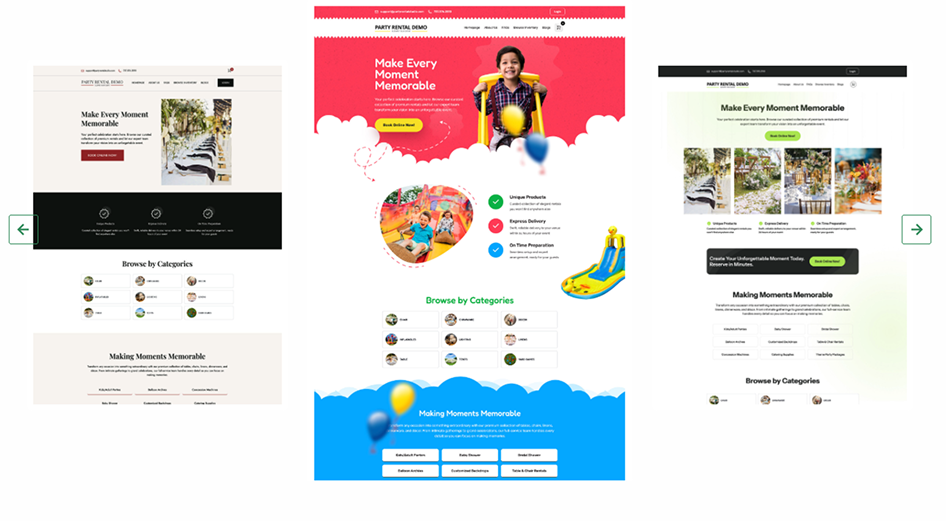
For rental business owners who want to skip the complexity and cost of custom website development, Party Rental Studio offers professionally designed website templates with seamless account integration. Your online catalog automatically populates with your inventory, complete with photos, descriptions, and real-time availability.
- Mobile-responsive design that works perfectly on all devices
- SEO optimization built into the structure and code
- Real-time inventory availability synchronized with your booking calendar
- Integrated shopping cart and checkout for a seamless customer experience
- Automated quote generation based on selected items and event details
- Secure payment processing for deposits and final payments
Organize Your Warehouse for Maximum Efficiency
Disorganized warehouses destroy profitability through wasted time, lost equipment, and operational chaos. A professional warehouse operation can prepare deliveries in 30 minutes that would take 2+ hours in a disorganized space.
Zone-Based Organization
Create dedicated zones for Furniture, Linens, Inflatables, Concessions, and Decor. Every item gets a designated home, and employees can locate any item within minutes without searching or asking questions.
Comprehensive Labeling Systems
Every shelf, bin, and storage location requires clear labels. Using alphanumeric systems (e.g., "Bin C7") enables anyone to retrieve specific items instantly, which is critical when scaling operations and hiring staff.
Dedicated Cleaning Station
Dirty equipment must never contaminate clean inventory. Establish a dedicated cleaning area with commercial washing machines, folding tables, and inspection protocols. Every returning item passes through cleaning, inspection, and repair before returning to active inventory.
Strategic Layout Design
The most-rented items (chairs, tables, basic linens) should be closest to loading docks. Specialty items can be stored deeper in the facility. Optimized layout saves 30-45 minutes per delivery by minimizing travel distance and handling time. Professional warehouse shelving systems cost $3,000-5,000 but pay for themselves within months through labor savings and error prevention.
Launch and Build Strategic Relationships
Outstanding inventory and operational systems mean nothing if potential customers don't know the business exists. Marketing and relationship-building are the lifeblood of rental business growth.
Strategic Networking
Join local wedding and event industry associations to connect with event planners, venues, caterers, and photographers. Regular attendance at industry meetings builds visibility and trust, and these relationships generate consistent referrals that form the foundation of sustainable revenue.
Partnership Development
Formal referral agreements with event planners, catering companies, and venues create win-win relationships. Offering 10% referral fees incentivizes partners to recommend your services. Three to five strong partnerships can generate $100,000+ in annual revenue.
Google My Business Optimization
This free tool is one of the most powerful marketing channels for local service businesses. Optimizing the profile, encouraging satisfied customers to leave reviews, and responding to all feedback builds local search visibility. Businesses with 100+ positive reviews receive priority placement in local search results.
Social Media and Email
Regular posting on Instagram and Facebook (3-4 times weekly) keeps the business top-of-mind. Pair that with a monthly email newsletter to past inquiries and customers, and email lists of 2,000-3,000 contacts can generate 5-10 inquiries per send.
Just start: Waiting for ideal conditions creates paralysis. Launch with available inventory and resources, then optimize based on real-world feedback and market response.
"The secret to getting ahead is getting started. The secret to getting started is breaking your complex, overwhelming tasks into small, manageable tasks, and then starting on the first one."
Mark TwainReady to Build Something Real?
Starting a party rental business requires significant effort, especially in the first year. 60-70 hour work weeks are common as founders handle every aspect from sales to delivery to cleaning. The work is physically demanding and operationally complex.
However, the rewards are substantial for those who execute effectively. Many operators reach $500,000-$1,000,000 in annual revenue within 5-7 years, with profit margins of 35-45%. These businesses often transition to 30-hour work weeks for owners as systems mature and staff is hired.
The market growth trajectory is clear, barriers to entry are manageable, and profit potential is real. Success requires disciplined systems, operational excellence, and unwavering commitment to customer service. The time to begin is now.
Ready to Start Your Party Rental Business?
Party Rental Studio gives you the tools to manage inventory, process bookings, and grow your business, all in one place. Start your free trial today, no credit card required.
Start My Free TrialFrequently Asked Questions
Get answers to the most common questions about starting your party rental business.
Is a party rental business profitable?
Yes, with the right plan and tools, it is incredibly rewarding. Typical profit margins range from 10% to 40%, and the market is growing fast. High-efficiency operators who master logistics and pricing can achieve margins of 45% or higher during peak seasons.
How much does it cost to start a party rental business?
Starting costs can range from $5,000 to $50,000 depending on the size and scope of your inventory. A typical starter setup of 50 tables, 400 chairs, and basic linens runs approximately $15,000. Many operators bootstrap from savings and reinvest profits to expand.
What are the most profitable rental items?
High-demand basics like white folding chairs, rectangular tables, and white linens generate the highest overall returns because of their constant turnover. Each piece pays for itself within 3-8 rentals and continues generating profit for years. As you scale, Chiavari chairs and specialty linens command premium rates.
References
IBISWorld. (2023). Party Supply Rental Market Size & Share 2018-2023. ibisworld.com
Entrepreneur. (2023). How to Start an Inflatable Business: Safety and Profit Guide. entrepreneur.com
Grand View Research. (2023). Party Supply Rental Market Size, Share, Growth Report 2030. grandviewresearch.com
InsurEdge. (2023). Do You Need Insurance for a Bounce House Rental Business? insuredge.com
Upmetrics. (2023). How to Start a Party Rental Business in 2023. upmetrics.co